This page is archived and kept only for reference. The information may be outdated or inaccurate, and the content may not meet current accessibility standards. If you need assistance, please email us at communications@nelson.wisc.edu.
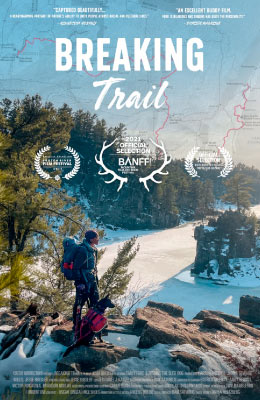
Explore Emily Ford’s experience as the first woman and person of color to embark on a thru-hike of the Ice Age Trail in winter during the Nelson Institute Tales from Planet Earth Film series screening and discussion of Breaking Trail. This special event will include an opportunity to screen the film on February 7 from 7-8:30 p.m. at the UW South Madison Partnership and February 8 from 7-8:30 p.m. at the Marquee Theater on the University of Wisconsin-Madison campus.
The event will feature a special conversation with Ford and Nelson Institute community partnership liaison, James Edward Mills, who will discuss Ford’s journey with her sled dog Diggins and the ways this experience tested their endurance, while also showcasing the unexpected kindness of strangers.
“I hope it helps pave the path for others to unabashedly go out and seek their own adventures. No matter who they are or what they look like,” Ford said of her mission to share this story. “Everyone has a dream – it may not be hiking 1200 miles in the winter – but it’s something I hope [will help] other folks feel empowered to blaze their own path.”
 Ford, who has become well-known for breaking barriers and strongly supporting initiatives that make the outdoors more accessible for all, says she did not set out to become an icon.
“I just wanted to do a long hike. I am laid off December to February so that’s the time I have to do anything like that. I was hoping to become a thousand miler,” Ford shared.
In fact, Ford says she originally set out to connect with nature.
“I love noticing what nature is doing,” Ford said. “When I spend enough consecutive days outside, I start to notice what the little dudes are doing in nature (i.e., insects, rodents, plants, and the movement of water) because they make up the big scene. I love the patterns that can be found out in the wild. Seasons are beautiful and nature follows those patterns and does what it needs to do. I want to hone that skill in my life.”
“I hope it helps pave the path for others to unabashedly go out and seek their own adventures. No matter who they are or what they look like.”
–Emily Ford
While Ford was focused on her connection with nature, she wasn’t alone. Her trail companion, a borrowed sled dog named Diggins, provided her support and assistance with the long trek.
“Ah Diggins, she’s my girl,” said Ford. “She was always a good check in on the trip. I think that as animals, humans do better if we have something to take care of. Having her to think of helped me not make too many bad [or] risky choices and be mindful of my physical [and] metal health… She’s also a great puller. I do want to be clear that she didn’t drag me across Wisconsin, but she definitely helped! We became best friends, she’s the best girl.”
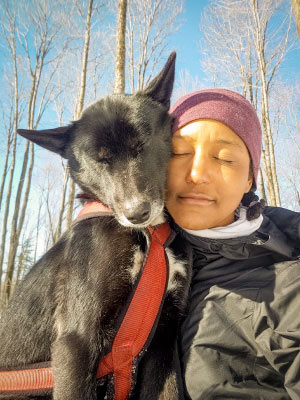
Photo credit: Emily Ford
In addition to Diggins, Ford was also joined virtually by her many social media followers who were supporting her journey and cheering her on from afar. As she shared her experience on social media, Ford began to see that her personal goals of connecting with nature and challenging herself had started to inspire others. By mile 500, Ford received a message from Jesse Roesler, a documentarian interested in filming Ford’s experience.
“Jesse sent me a message on Instagram and I took some time on a zero day to think about if I wanted to say yes. Like most things in my life, I figured a “yes” wouldn’t hurt,” Ford said. “The story is about me and Diggins and our trek across Wisconsin in the middle of the pandemic and a bit after George Floyd’s murder. He [Roesler] pushed out the message that I firmly believe in which is everyone deserves to feel safe in the outdoors and the outdoors is for everybody.”
This message is what Ford hopes her film, which premiered at the Banff Film Festival, and events like Tales from Planet Earth will bring to others.
“It’s important,” said Ford. “Every person is important and we as a collective are important. That includes everything under the sun.”
Learn more about this event and related partner events, and register here.